Pain in the shoulder, chest, and arm can be a complex issue with many potential causes. One condition that is gaining more recognition, often called the forgotten pectoralis minor syndrome, is a significant source of this discomfort. It affects the upper extremity by causing compression of vital nerves and blood vessels, yet it is frequently overlooked.
This post will provide a deep dive into Pectoralis Minor Syndrome (PMS). We’ll explore why it’s sometimes called the forgotten pectoralis, explain the clinical presentation of symptoms, and cover the full spectrum of modern treatment options available to provide relief.
Pectoralis Minor Anatomy
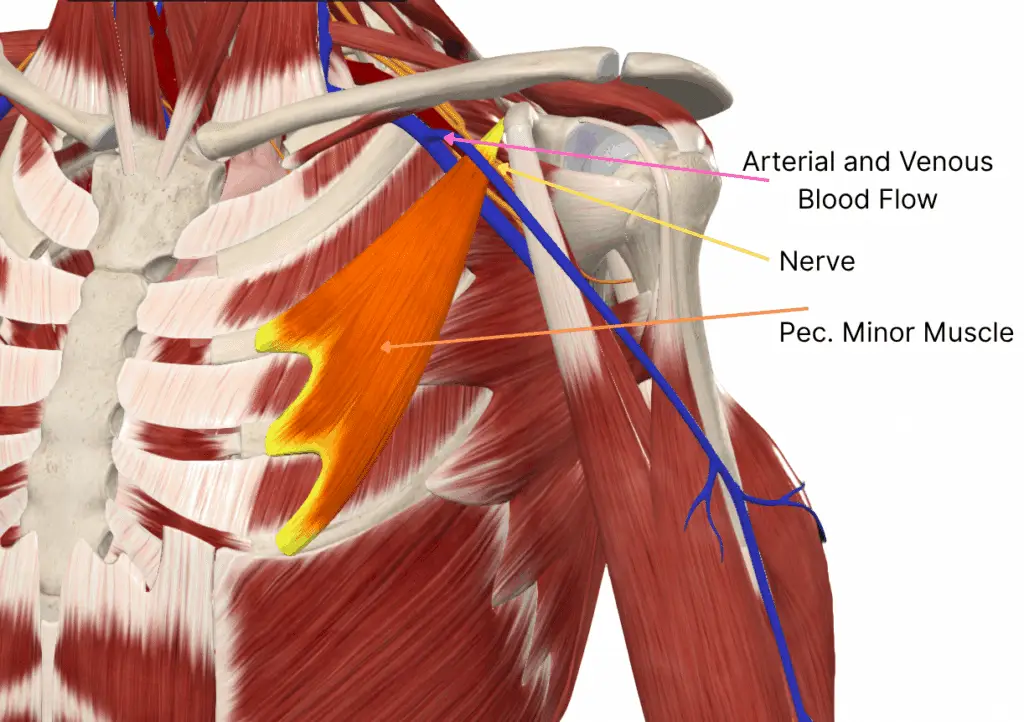
To understand this condition, let’s first look at the anatomy. The pectoralis minor is a small, triangle-shaped muscle located on the anterior chest wall, directly underneath the much larger pectoralis major muscle. Together, these are known as the pectoral muscles. The pectoralis minor attaches to your 3rd, 4th, and 5th ribs on the rib cage and connects to a part of your shoulder blade called the coracoid process of the scapula.¹
Although small, this PM muscle plays a big role in shoulder movement and stability. However, due to factors like poor posture (rounded shoulders), repetitive overhead activity (arm elevation), or a shoulder injury, the pectoralis minor can become tight and shortened. When this happens, it creates a bottleneck in the small area underneath it, known as the minor space.
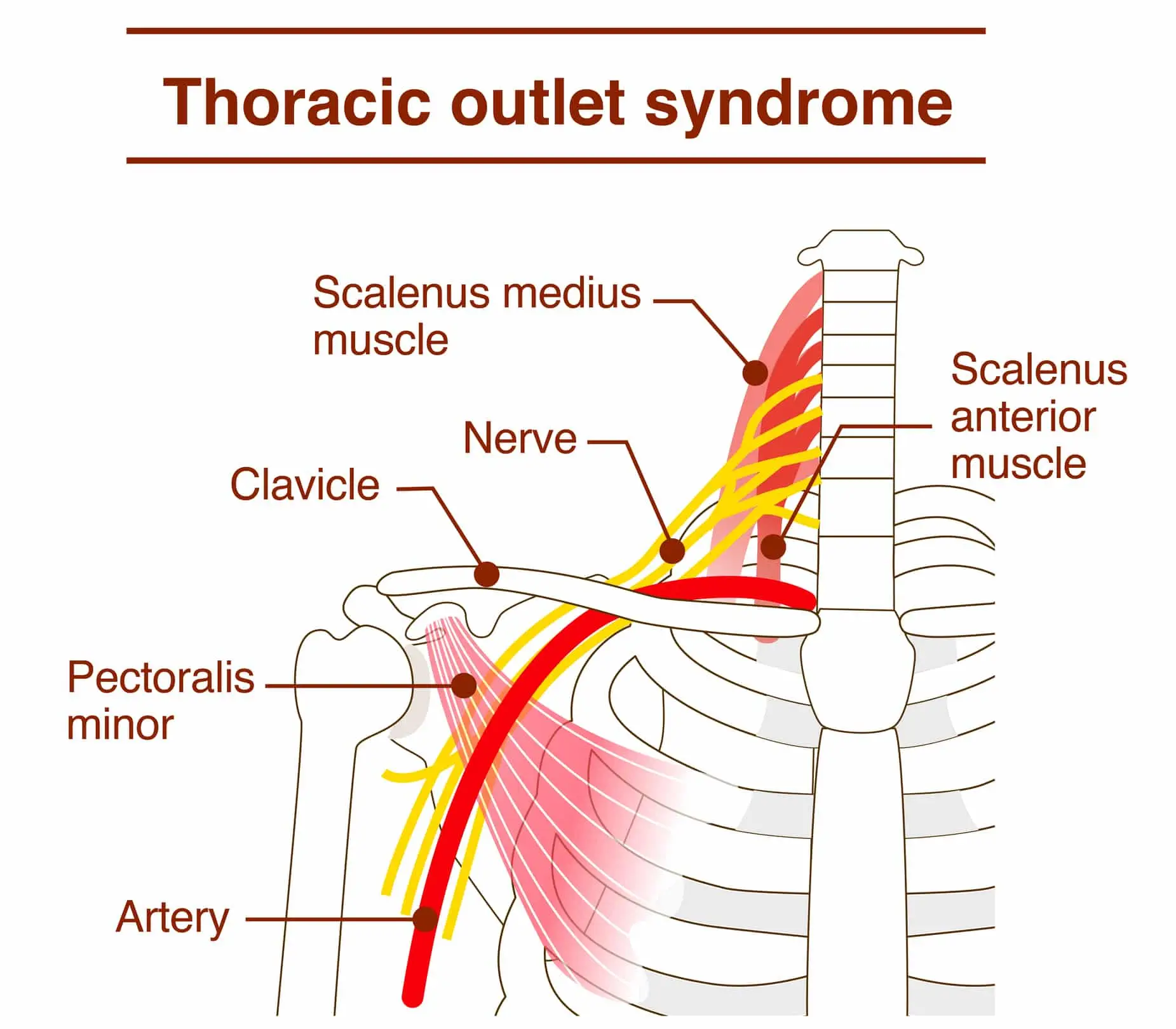
This space is a critical passageway for the neurovascular structures of the upper limb. A tight pectoralis minor can squeeze this compression of the neurovascular bundle, which includes:¹
The Brachial Plexus: The main network of brachial plexus nerves that travel from the neck and spinal cord to the upper arm and hand. This compression often specifically affects the medial cord of the plexus, which contributes to the ulnar nerve.
The Axillary Artery and Vein: These are the primary blood vessels that supply the arm. The subclavian artery and subclavian vein become the axillary vessels as they pass through this region.
This specific Subclavicular Brachial Plexus Compression is the defining feature of Pectoralis Minor Syndrome. It’s important to differentiate PMS from the broader diagnosis of Thoracic Outlet Syndrome (TOS), which refers to compression in other areas like the scalene triangle (between the anterior scalene muscle and middle scalene muscles) or the costoclavicular space (between the collarbone and the first rib). The presence of a cervical rib (an extra rib) is a known cause of TOS, but pectoralis minor syndrome alone can exist without these other issues.¹,²
Common Symptoms of Pectoralis Minor Syndrome
Because the nervous system is directly involved, the symptoms of PMS can be varied and radiate far from the actual muscle. This is why making a differential diagnosis is so crucial, as PMS can present with similar symptoms to carpal tunnel syndrome, rotator cuff injuries, or issues with a nerve root in the neck.
If you have PMS, you might experience:
Pain: Aching or sharp pain in the anterior shoulder, chest, and armpit. This is often accompanied by neck pain and sometimes even occipital headaches.²
Neurogenic Symptoms: This is the most common presentation, known as neurogenic PMS. It involves compression of the brachial plexus, leading to numbness, tingling, or burning sensations that radiate down the arm into the hand.²
Vascular Symptoms: Less common, but compression of the blood vessels can cause venous obstruction or arterial issues. This can lead to swelling (axillary vein obstruction), a feeling of heaviness in the arm, or discoloration. This is sometimes called venous PMS.
Weakness and Fatigue: A feeling of heaviness in the arm, a weaker grip, and general fatigue, especially with overhead activities. This is often linked to poor scapular kinematics (abnormal movement of the shoulder blade), also known as scapular dyskinesis. This abnormal movement can be both a cause and a result of PMS, involving other muscles like the latissimus dorsi and levator scapulae.³,⁴
Muscle Spasm: The PM muscle itself can go into a painful muscle spasm, worsening the compression.
How is Pectoralis Minor Syndrome Diagnosed?
A definitive clinical diagnosis often requires a careful process of elimination. A healthcare provider will start with a thorough physical examination and a detailed discussion of your symptoms.
Diagnostic steps typically include:
Palpation and Provocative Tests: Your doctor will press on the area of the minor tendon below your collarbone. If this action reproduces your symptoms, it’s a strong indicator. Physical tests that involve arm elevation, like the elevated arm stress test, are also used to trigger symptoms and confirm the diagnosis.¹
Diagnostic Muscle Block: A minor muscle block is a highly effective diagnostic tool. Using ultrasound for guidance, a local anesthetic is injected into the pectoralis minor muscle. A positive response—meaning your symptoms are significantly relieved for the duration of the anesthetic—helps confirm that the PM muscle is the source of the compression.²,⁵
Imaging: While standard X-rays may be used to look for a cervical rib, advanced imaging like magnetic resonance imaging (MRI) can be valuable for the differential diagnosis, helping to rule out other causes of nerve compression. In cases of suspected venous obstruction, a dynamic venography may be used to visualize blood flow.²
How to Treat Pectoralis Minor Syndrome
Treatment for Minor Compression Syndrome focuses on releasing the tight muscle to relieve the neurovascular compression. A range of effective options is available, starting with conservative methods and progressing if needed.
Physical Therapy & Postural Correction
For most people, physical therapy is the cornerstone of treatment. The goal is to correct the underlying mechanical issues. A therapist will guide you through:
Stretching: Gentle stretches to lengthen the tight pectoralis minor muscle and tendon.³
Strengthening: It’s crucial to strengthen the muscles that support good posture, including the upper back and shoulder blade stabilizers. This improves scapular kinematics and takes the strain off the chest muscles.³
Postural Education: Learning how to maintain a healthy posture during daily activities is key to long-term success.
Acupuncture and Dry Needling
These therapies are excellent for targeting muscle spasm and specific points of tension known as myofascial trigger points.
Dry Needling: A practitioner inserts a thin needle directly into a trigger point in the right pectoralis or left, depending on the side of injury. This often causes a “local twitch response”—an involuntary muscle contraction that helps the muscle relax, reduces pain, and improves mobility.⁶
Acupuncture: This practice can also be very effective for releasing muscle tension, improving blood flow, and reducing pain by targeting specific pectoral nerves and trigger points.
Injections for Pain Relief
If manual therapies aren’t providing enough relief, injections can be a powerful next step.
Botulinum Toxin Injections: Injecting Botox® (OnabotulinumtoxinA) into the pectoralis minor muscle can temporarily relax it, providing significant symptom relief for several months. This not only treats the pain but also serves as a final diagnostic confirmation before considering surgery.⁵,⁷
Surgery
When symptoms are severe and do not respond to months of conservative treatment, surgery may be an option. This is often performed by a Vascular Surgery specialist.
Pectoralis Minor Release: The most common surgery is a minor release (tenotomy), where the surgeon cuts the tendon of the pectoralis minor. This permanently releases the compression on the brachial plexus lesions. The success rate for this procedure is high in carefully selected patients, as detailed in numerous studies found on Google Scholar and in journals like the Annals of Vascular Surgery.⁸,⁹
Thoracic Outlet Decompression: In some cases, the minor release is part of a larger thoracic outlet decompression surgery, which might also include removing a cervical rib or performing a first rib resection.
Final Thoughts
The forgotten pectoralis minor syndrome is a real and treatable cause of significant shoulder, arm, and neck pain. Because its symptoms can mimic other conditions, a precise clinical diagnosis from a qualified healthcare professional is essential to avoid unnecessary treatments and potential nerve damage. With the right combination of modern therapies—from physical therapy and dry needling to advanced injections and surgical release—it is possible to find lasting relief.
References
Roche S, Tadi P. Pectoralis Minor Syndrome. In: StatPearls. StatPearls Publishing; 2024. NIH
Karapolat H, Korkmaz FF, Cizmecioglu M, Guler M. Pectoralis minor syndrome. Agri. 2022;34(4):252-258. doi:10.14744/agri.2021.46317 PubMed
Physiopedia. Pectoralis Minor. Physiopedia. Accessed June 3, 2025. Physio Pedia
Kuhn JE, Plancher KD, Hawkins RJ. Scapular winging. J Am Acad Orthop Surg. 1995;3(6):319-325. doi:10.5435/00124635-199511000-00004 PubMed
Torres-Pruñonosa J, Puig-Verdié L, Pozo-Rosich P, et al. Role of Botulinum Toxin in Pectoralis Minor Syndrome: A Novel Therapeutic and Diagnostic Tool. A Cohort Study. J Clin Med. 2021;10(22):5242. Published 2021 Nov 11. doi:10.3390/jcm10225242 PubMed
Dede Ö, Dede F, Ayhan F, Karapolat H. Dry needling with blinded technique in pectoralis minor syndrome. Agri. 2023;35(3):233-234. doi:10.14744/agri.2022.37258 PubMed
Roche S, Gnanasegaran G, Bown J, Brealey S, Gorthy S, Johnson M. Pectoralis minor syndrome: diagnosis with Botulinum injection and treatment with tenotomy – a prospective case series. Shoulder & Elbow. 2022;14(5):548-554. doi:10.1177/1758573221990422 PubMed
Illuminati G, Papeo G, Pizzardi G, et al. Pectoralis Minor Tenotomy for the Treatment of Neurogenic Thoracic Outlet Syndrome. Annals of Vascular Surgery. 2020;67:361-367. doi:10.1016/j.avsg.2020.03.024 PubMed
Sanders RJ, Rao NM. The Forgotten Pectoralis Minor Syndrome: 100 Operations for Pectoralis Minor Syndrome. Annals of Vascular Surgery. 2019;54:145-151. doi:10.1016/j.avsg.2018.06.024 PubMed
Jaw muscle pain, especially in the masseter, can make jaw movement, chewing, and even smiling difficult. This powerful skeletal muscle plays a crucial role in elevating the lower jaw and…
That persistent ache between your shoulder blades, the sharp shoulder pain under your scapula, or the burning muscle tension in your upper back – these are all-too-familiar complaints for many…
Benign Prostatic Hyperplasia (BPH)—or enlarged prostate—is a common condition that affects nearly half of all men over age 50, and up to 90% by age 80.¹ While BPH is not cancerous, it…
118 W. 72nd, Rear Lobby, Upper West Side, NY 10023 Evidence-based acupuncture and dry needling on the Upper West Side, NYC. From chronic pain, headaches, and pelvic floor dysfunction, Dr. Jordan Barber integrates the highest level of training with compassionate care to help you thrive. Disclaimer: This site does not provide medical advice. Always consult a qualified healthcare professional before making changes to your health. Read our full disclaimer
Quick Links
Got Questions?
Limited spots available each week book now to reserve yours