Unlocking Your Shoulder: Finding Lasting Relief from Pain on NYC’s Upper West Side with Acupuncture
Shoulder pain can be a real burden, significantly limiting your ability to perform daily activities and impacting your quality of life here in New York City. The shoulder, a complex ball-and-socket joint, offers an incredible range of motion thanks to its intricate structure of multiple muscles and joints. Unfortunately, this complexity also makes it prone to a variety of painful shoulder disorders, from general tightness and rotator cuff injuries like rotator cuff tendinitis, to more severe conditions like adhesive capsulitis (frozen shoulder) or shoulder impingement syndrome. At our Upper West Side clinic, Dr. Jordan Barber, a licensed acupuncturist, employs a specialized acupuncture treatment approach that looks beyond the immediate site of pain to uncover and treat the true cause of the pain, offering an effective treatment for these chronic conditions.
Beyond the “Point of Pain”: Identifying the Real Cause of Your Shoulder Problem
A crucial understanding in the effective treatment of shoulder pain is that “the point of pain is not necessarily the point of injury.” You might feel pain in the front of the shoulder because a rotator cuff tendon is rubbing over a bone, causing inflammation – a common issue in subacromial impingement syndrome. While addressing this local inflammation might offer short-term relief, it often doesn’t address the underlying reason why that soft tissue is being irritated.
More often than not, the root cause can be a minor acute injury or the development of a muscle knot (trigger point) in muscle tissue located further away – perhaps in your upper back, shoulder blade area, neck (contributing to chronic neck pain which can influence shoulder issues), or even your chest muscles. Such a knot can subtly shorten the muscle. This shortening then pulls on the rotator cuff tendons, making them tighter as they pass over bony structures in the shoulder socket joint, leading to inflammation and pain. Poor posture maintained for long periods can also contribute significantly. For true and lasting healing, and to prevent recurrence of shoulder injuries, it’s imperative to find and release these contributing muscle knots and address the entire affected area.
How Acupuncture and Dry Needling Offer Comprehensive Pain Management for Shoulder Pain
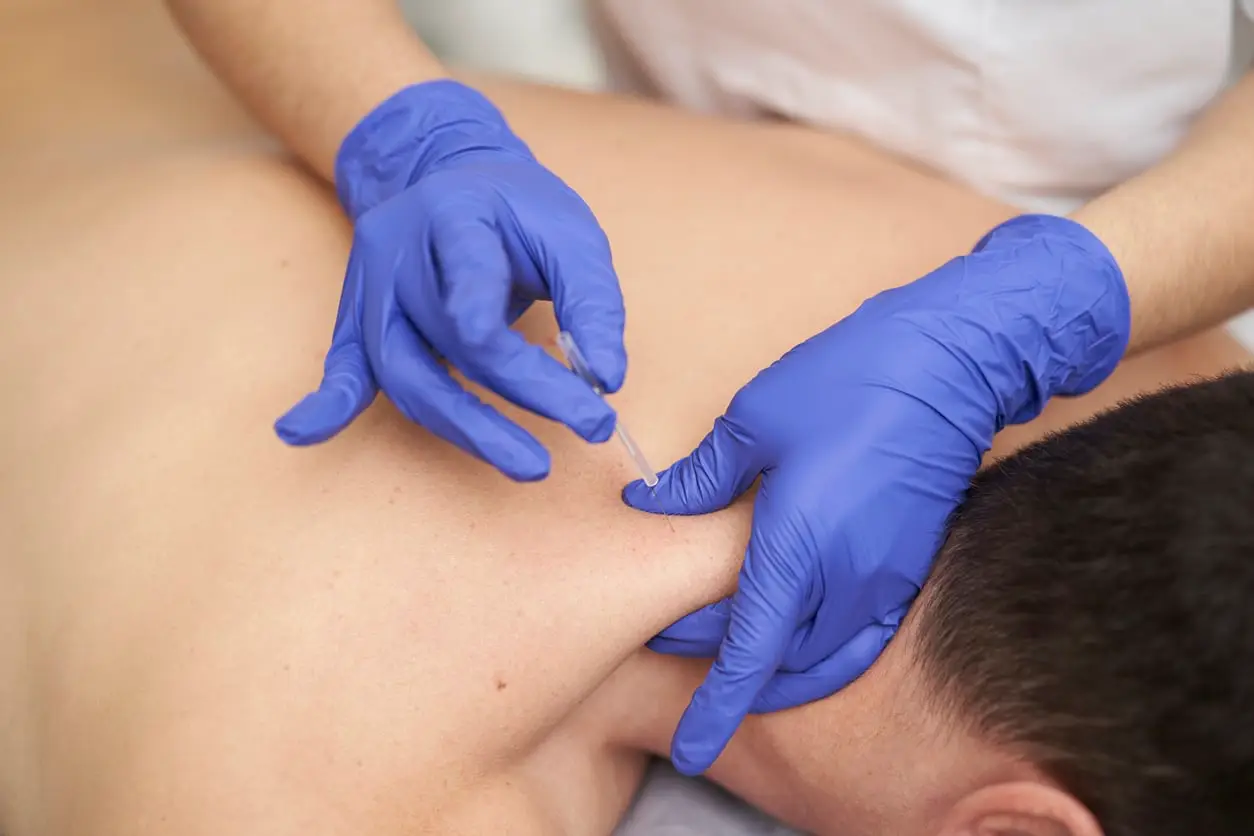
Dr. Jordan Barber utilizes both traditional acupuncture, a therapy rooted in Traditional Chinese Medicine (or Oriental Medicine), and dry needling to provide a comprehensive solution. This approach involves meticulously assessing and treating not only the painful shoulder joint itself but also the surrounding and often contributing areas. This is key because a shoulder problem will often lead to treatment possibly covering the upper back, scapula, neck, or pecs.
Acupuncture for Pain Reduction and the Healing Process:
Acupuncture works in various ways to alleviate shoulder pain and promote healing. Research studies, including those found in the Cochrane Library or J Altern Complement Med, demonstrate its benefits:
Reducing Pain and Inflammation: It helps alleviate local pain and inflammation in conditions like bursitis or rotator cuff disease by stimulating the nervous system and promoting anti-inflammatory responses.¹ Common symptoms often see significant reduction.
Releasing Muscle Tension: Acupuncture needle insertion at specific points, including distal points or points along channels like the Small Intestine meridian which traverses the shoulder, can relax tight muscles around the shoulder, neck, and upper back.
Improving Blood Flow: Enhanced circulation to the shoulder area supports tissue healing and can help resolve scar tissue contributing to chronic shoulder pain.
Restoring Joint Mechanics: By addressing muscular imbalances, acupuncture helps restore more normal movement patterns. The efficacy of acupuncture in these areas is well-documented, and it often has fewer side effects than some conventional treatment options.
Dry Needling for Precise Trigger Point Deactivation:
Dry needling is exceptionally effective for targeting the specific muscle knots that are often the hidden drivers of shoulder pain and dysfunction:
Targeting Rotator Cuff Muscles: Precise needling can release trigger points in the rotator cuff muscles (supraspinatus, infraspinatus, teres minor, teres major, subscapularis) which are common sources of pain and weakness in rotator cuff injuries, even in some cases of rotator cuff tears (where it helps manage pain and improve function, though it doesn’t repair a full tear).
Addressing Referred Pain Sources: Dry needling can deactivate trigger points in muscles like the trapezius or pectoralis minor that frequently refer pain to the shoulder or contribute to impingement syndromes.²
Restoring Muscle Length and Function: Releasing these knots helps restore the muscle to its optimal length, taking pressure off inflamed structures.
Many randomized controlled trials compare an acupuncture group to a control group (sometimes using sham acupuncture) to assess primary outcomes using tools like a Disability Index. While some may claim “little evidence” for certain alternative medicine approaches, a careful look at research often shows significant improvements with acupuncture therapies for many types of pain, including shoulder disorders. Adverse events are rare when performed by a skilled practitioner.
Fast-Tracking Your Recovery on the Upper West Side
At his NYC clinic, Dr. Jordan Barber conducts a detailed assessment to map out these patterns of tension. By correctly identifying and treating these underlying causes, even severe shoulder conditions, including sports injuries or pain from rheumatoid arthritis affecting the shoulder, can often heal relatively quickly. When the musculoskeletal structure is corrected, the body can reset. This approach can be a valuable part of pain management, often complementing physical therapy or exercise therapy.
If shoulder pain is restricting your daily activities, it’s time to consider an approach that addresses the complete picture. Contact our Upper West Side clinic today to schedule your first acupuncture consultation with Dr. Jordan Barber and learn how targeted acupuncture and dry needling can help you achieve lasting relief.
Dong W, Goost H, Lin XB, et al. Acupuncture for shoulder pain. Cochrane Database Syst Rev. 2019;5(5):CD005319. PubMed
Pourahmadi MR, Keshtkar AA, Shariati A, et al. Effectiveness of dry needling on pain intensity, pressure pain threshold, and disability in patients with subacromial pain syndrome: A systematic review and meta-analysis. Pain Med. 2021;22(9):2071-2085. PubMed
Sun N, Liu J, Li W, et al. Acupuncture for Adhesive Capsulitis: A Systematic Review and Meta-Analysis. Evid Based Complement Alternat Med. 2020;2020:8875905. PubMed
Erectile Dysfunction (ED) is a prevalent condition that can significantly impact quality of life. While commonly attributed to hormonal or psychological factors, emerging evidence highlights the role of pelvic floor dysfunction, impaired penile…
If you’re exploring treatments for pain, you’ve likely encountered both dry needling and acupuncture. Since both therapies use thin, sterile needles, it’s easy to assume they are the same. However,…
If you’ve ever dealt with that stubborn knot in your shoulder that never seems to go away, the deep ache in your low back after a long day, or a…
118 W. 72nd, Rear Lobby, Upper West Side, NY 10023 Evidence-based acupuncture and dry needling on the Upper West Side, NYC. From chronic pain, headaches, and pelvic floor dysfunction, Dr. Jordan Barber integrates the highest level of training with compassionate care to help you thrive. Disclaimer: This site does not provide medical advice. Always consult a qualified healthcare professional before making changes to your health. Read our full disclaimer
Quick Links
Got Questions?
Limited spots available each week book now to reserve yours